
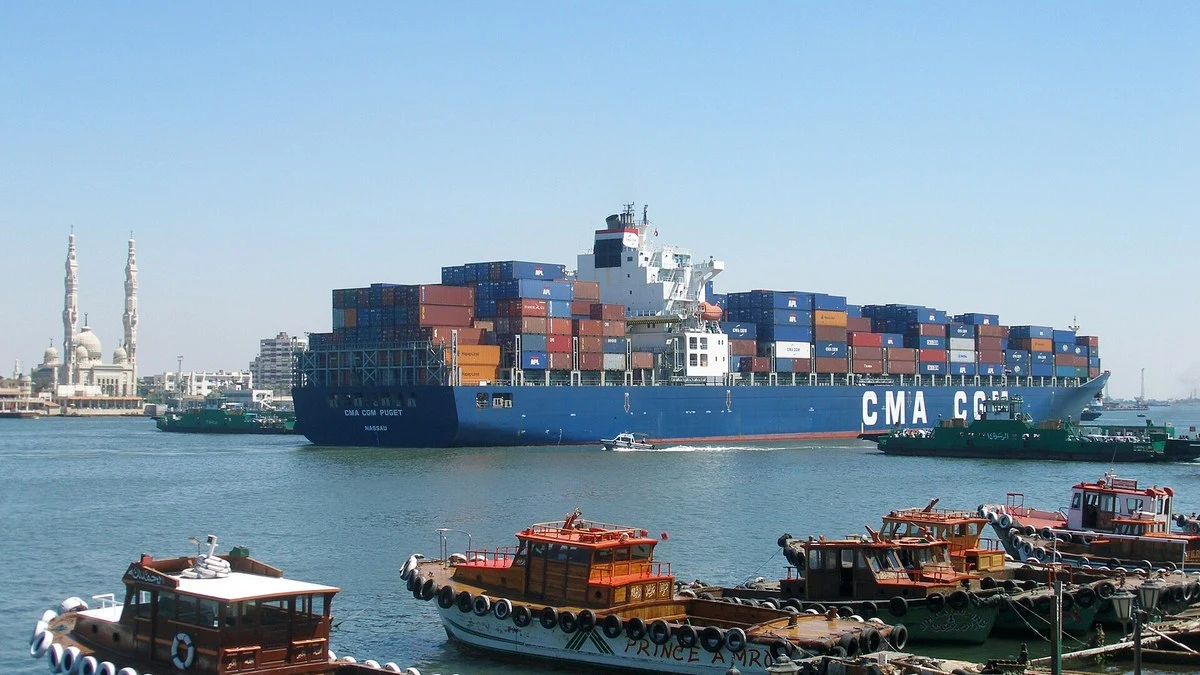
Capital expansion across Suez Canal Ports 2026 highlights how global terminal operators are upgrading Egypt’s intercontinental maritime corridor into a bonded manufacturing and multimodal distribution engine. Prepared by El Tahrir News English Edition, this trade analysis examines four port, logistics-park, and rail-integration investments pushing cumulative Suez Canal Economic Zone (SCZONE) inflows past $16 billion.
Table of Contents
Global Container Share at East Port Said and Sokhna
Sitting astride the maritime artery linking Mediterranean and Red Sea shipping lanes, the Suez Canal Economic Zone anchors a trade corridor handling roughly 12% of global trade and approximately 20% of worldwide container traffic. Rather than functioning purely as a pass-through transit channel, Egypt’s twin deepwater hubs at East Port Said and Ain Sokhna increasingly capture value-added transshipment, cargo consolidation, and bonded light industrial processing.
Expanding port throughput and bonded warehousing capacity strengthens Egypt’s foreign-exchange inflows from maritime services and export manufacturing, connecting directly to trends examined in our report on hard-currency trade settlement and USD-EGP dynamics in 2026.
Port modernization also intersects with industrial decarbonization across Red Sea and Mediterranean logistics parks, where electrified cranes and renewable energy supplies align with projects detailed in our coverage of Egypt’s 2026 solar power and clean infrastructure investments.
Four Logistics Investments Reshaping Suez Canal Ports 2026
Four verified infrastructure and terminal milestones define how global maritime operators and Egyptian planners are scaling container capacity and inland freight velocity across 2026:
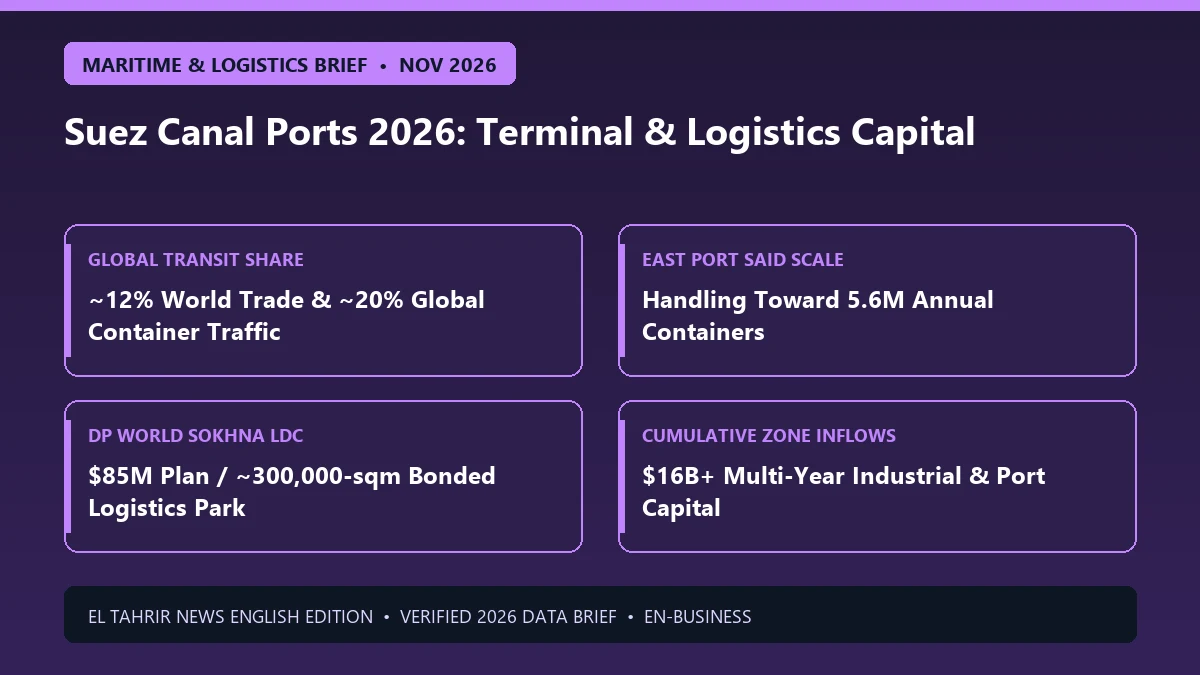
- East Port Said Container Handling Toward 5.6 Million Units: Mediterranean terminal upgrades pushed East Port Said container handling capacity toward roughly 5.6 million containers, reinforcing its standing among the eastern Mediterranean’s highest-volume deepwater transshipment gateways.
- DP World’s $85 Million Sokhna Logistics Distribution Centre: DP World launched Egypt’s first integrated Logistics Distribution Centre (LDC) at Sokhna Logistics Park, backed by an $85 million investment spanning ~300,000 square meters of bonded warehousing and multimodal customs clearance just minutes from Sokhna Port.
- APM Terminals and Maersk Network Optimization: APM Terminals and parent A.P. Moller-Maersk continue optimizing Asia-Europe maritime transshipment flows by pairing East Port Said’s Mediterranean berths with Red Sea access at Sokhna.
- Over $16 Billion in Cumulative SCZONE Capital: Cumulative industrial, port, and logistics investments across SCZONE surpassed $16 billion alongside electric high-speed rail and inland dry port integration linking ports directly to domestic industrial zones.
Positioning 300,000 square meters of bonded warehousing and multimodal customs clearance minutes from Sokhna Port turns simple vessel calls into agile regional supply-chain hubs.
Terminal Metrics and DP World Egypt Logistics Portal
Supply-chain managers, freight forwarders, and industrial tenants evaluating bonded storage specifications and port access can review official details through the DP World Egypt & SCZONE Port Logistics portal. Verified 2026 maritime benchmarks include:
| Port or Logistics Asset | Operator / Authority | Verified 2026 Capacity and Capital Data |
|---|---|---|
| SCZONE Maritime Corridor | Suez Canal Economic Zone | Handles ~12% of global trade and ~20% of worldwide container traffic |
| East Port Said Port | SCZONE / APM Terminals & Maersk | Container handling expanded toward ~5.6 million containers |
| Sokhna Logistics Park (LDC) | DP World Egypt | $85 million investment; ~300,000 sqm bonded warehousing and multimodal clearance |
| Asia-Europe Transshipment | APM Terminals / A.P. Moller-Maersk | Coordinated dual-sea routing using East Port Said and Sokhna |
| Zone-Wide Capital & Rail | SCZONE & National Rail Network | $16 billion+ cumulative investments with electric high-speed rail and dry ports |
Electric High-Speed Rail and Dry Port Cargo Connectivity
Physical berth expansion delivers full economic dividends only when containers clear port gates rapidly into hinterland factories and consumption centers. By pairing DP World’s integrated Sokhna Logistics Distribution Centre with electric high-speed rail links and inland dry ports, SCZONE planners reduce dwell times and highway bottlenecks between the Red Sea, Greater Cairo, and Mediterranean outlets. Bonded warehousing inside Sokhna Logistics Park also lets regional distributors stage inventory efficiently without premature customs friction.
That dual-coast multimodal architecture appeals directly to global carriers such as A.P. Moller-Maersk and APM Terminals seeking resilient Asia-Europe transshipment hubs. With East Port Said scaling toward 5.6 million containers and cumulative SCZONE investments topping $16 billion, Egypt’s port ecosystem increasingly competes on end-to-end customs speed, synchronized rail transfers, bonded cargo consolidation, and lower-emission inland freight connectivity rather than geographic location alone.
Frequently Asked Questions on SCZONE Maritime Terminals
What share of global maritime trade moves through the Suez Canal corridor?
The SCZONE corridor handles roughly 12% of global seaborne trade and approximately 20% of worldwide container traffic, positioning East Port Said and Sokhna at the center of Asia-Europe supply chains.
What does DP World’s $85 million Sokhna Logistics Distribution Centre offer?
Launched at Sokhna Logistics Park, Egypt’s first integrated LDC spans roughly 300,000 square meters of bonded warehousing and multimodal customs clearance located minutes from Sokhna Port.
How far has SCZONE cumulative investment grown alongside East Port Said?
Cumulative SCZONE investments have surpassed $16 billion alongside electric high-speed rail and dry port integration, while East Port Said container handling expanded toward roughly 5.6 million containers.
Financial Disclaimer: This maritime and trade journalism report is published for informational purposes only based on official port operator and SCZONE disclosures; it does not constitute commercial shipping or investment advice.

