
Tracking the Egypt IMF Review 2026 shows how Cairo’s stabilization program has shifted from emergency currency adjustments toward measurable disinflation and non-oil growth. In this macroeconomic dispatch from El Tahrir News English Edition, we examine five inflation, growth, and fiscal anchors guiding Egypt’s $8 billion Extended Fund Facility, parallel resilience track, and technical policy reviews across 2026.
Table of Contents
Disinflation Progress and Energy Subsidy Calibration
Headline consumer price data in 2026 highlights substantial progress compared with Egypt’s late-2023 inflation surge near 38%. Urban annual inflation cooled into a 12.7% to 14.5% corridor during 2026, reflecting tighter monetary conditions and calmer global commodity import costs. Food and beverage price moderation anchored much of that deceleration, easing household budget pressure across staples after prolonged price volatility.
Even as grocery inflation moderated, fiscal policymakers executed phased fuel and energy subsidy adjustments designed to narrow budget deficits and curb off-balance-sheet energy arrears. Absorbing those regulated price adjustments without reigniting broader core inflation became a central benchmark during joint Cairo and virtual technical reviews, reinforcing links between public-finance discipline and domestic Central Bank interest-rate calibration in 2026.
Market participants tracking Egyptian sovereign risk also monitor how monetary tightening interacts with interbank foreign-exchange clearing and USD-EGP exchange-rate stability in 2026. Maintaining unified, market-clearing currency access eliminates parallel-market pricing distortions that previously amplified import pass-through into retail food and manufacturing inputs.
Five Macroeconomic Anchors Shaping the Egypt IMF Review 2026
Five structural benchmarks define policy dialogue between Egyptian authorities and International Monetary Fund staff under the ongoing $8 billion financing framework:
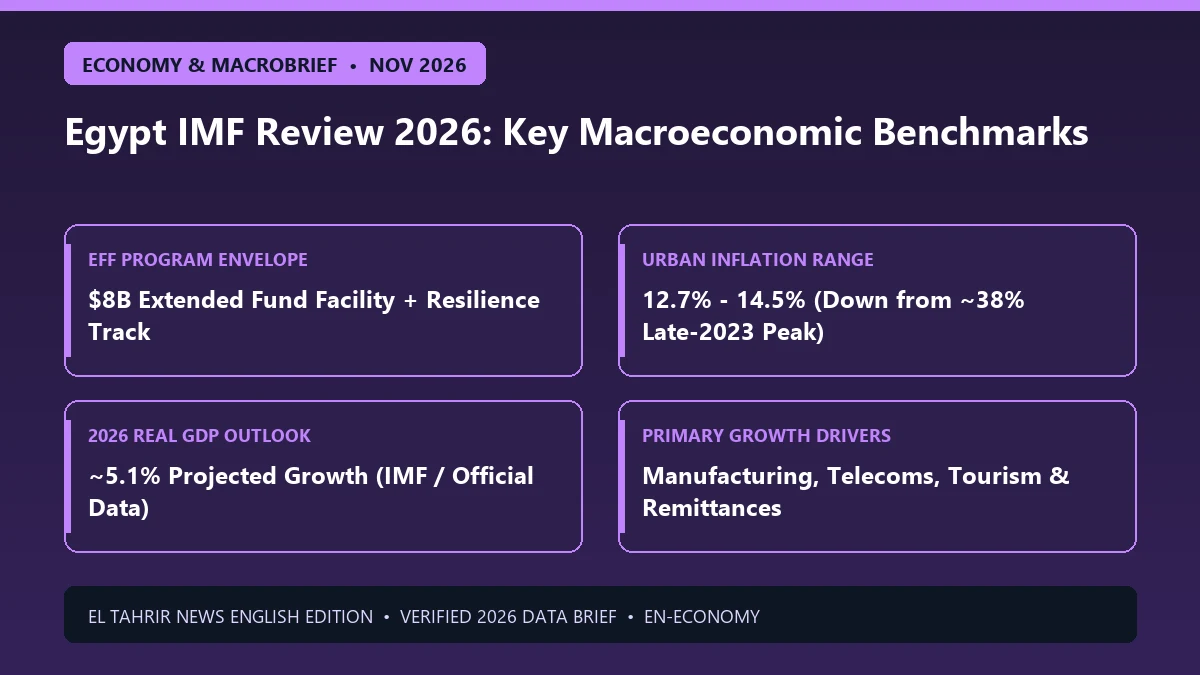
- Urban Inflation Cooling to 12.7%–14.5%: Headline urban inflation fell sharply from its ~38% peak in late 2023 as food and beverage prices moderated despite phased fuel and energy subsidy adjustments.
- $8 Billion Extended Fund Facility Plus Resilience Track: Cairo’s program pairs the $8 billion Extended Fund Facility (EFF) with a parallel resilience track focused on climate adaptation, energy transition financing, and concessional external support.
- Active Cairo and Virtual Technical Policy Reviews: Regular technical missions conducted in Cairo and remotely evaluate quantitative performance criteria, structural benchmarks, and state-enterprise governance milestones.
- Fiscal Consolidation and Primary Surplus Discipline: Treasury planning prioritizes sustained primary budget surpluses and broader tax administration reforms to stabilize public debt trajectories while safeguarding targeted social transfers.
- Exchange-Rate Flexibility and 5.1% Growth Outlook: Ongoing exchange-rate flexibility underpins the IMF’s 2026 real GDP growth projection of roughly 5.1%, supported by non-oil private enterprise and stronger foreign capital confidence.
Bringing urban inflation down from roughly 38% in late 2023 to a 12.7%–14.5% range while implementing phased energy subsidy reforms demonstrates how coordinated fiscal and monetary discipline anchors investor confidence.
Fiscal Benchmarks and Official IMF Country Portal
Economists, institutional bondholders, and corporate planners seeking official staff assessments, program documentation, and country economic tables can consult the Egypt State Information Service (SIS) Economy & IMF Portal directly. Core verified indicators framing 2026 technical reviews include:
| Macroeconomic Indicator | Verified 2026 Benchmark | Policy Context and Driver |
|---|---|---|
| Urban Annual Inflation | 12.7%–14.5% (down from ~38% late-2023 peak) | Food and beverage moderation offsets phased fuel subsidy adjustments |
| IMF Financing Architecture | $8B Extended Fund Facility + resilience track | Anchors external financing, structural reform, and climate resilience |
| 2026 Real GDP Growth Outlook | ~5.1% (IMF projection) | Driven by non-oil manufacturing, telecoms, tourism, and remittances |
| Technical Review Format | Active Cairo and virtual policy reviews | Tracks fiscal consolidation, primary surplus, and FX flexibility |
| External Offset Factors | Gulf/FDI inflows + non-oil expansion | Counters Red Sea shipping pressure on Suez Canal receipts |
Non-Oil Growth Engines Versus Red Sea Shipping Pressures
Beneath headline macro ratios, the composition of Egypt’s ~5.1% real GDP growth outlook reflects encouraging sectoral diversification. Non-oil manufacturing output has recovered alongside steadier industrial raw-material imports, while telecommunications, hospitality, and tourism arrivals contribute durable service-export earnings. Diaspora remittances flowing through formal Egyptian banks provide an additional consumer and balance-of-payments pillar throughout 2026.
That broad-based domestic momentum remains essential because Red Sea shipping disruptions continue weighing on Suez Canal transit receipts. Rather than derailing external accounts, softer maritime tolls have been offset by sustained Gulf investment commitments, broader foreign direct investment inflows, and resilient non-oil exports—allowing fiscal and monetary authorities to maintain exchange-rate flexibility without depleting strategic reserves.
Frequently Asked Questions on Egypt’s IMF Program
What inflation range has Egypt achieved under the 2026 IMF program?
Urban annual inflation cooled to a 12.7% to 14.5% range in 2026, down substantially from its late-2023 peak near 38%, supported by food and beverage price moderation alongside phased fuel and energy subsidy adjustments.
What are the main pillars of the $8 billion Extended Fund Facility?
Alongside a complementary resilience track, the $8 billion EFF centers on fiscal consolidation, sustaining a primary budget surplus, maintaining exchange-rate flexibility, and completing regular Cairo and virtual technical policy reviews.
What drives the IMF’s 5.1% real GDP growth projection for 2026?
Roughly 5.1% projected real GDP growth is powered by non-oil manufacturing, telecommunications, tourism, and diaspora remittances, with Gulf investments and FDI offsetting Red Sea shipping pressures on Suez Canal receipts.
Financial Disclaimer: This economic analysis is provided for informational purposes only based on official macroeconomic releases and institutional program data; it does not constitute investment, currency, or financial advice.

