Modern AI Cybersecurity Frameworks 2026 took center stage across enterprise chief information security officer panels at Cairo ICT 2026 and the co-located AIDC2 Expo in New Cairo. In this technical analysis prepared by El Tahrir News English Edition, we examine how rapid generative artificial intelligence deployment and cloud automation have widened enterprise attack surfaces, forcing regional security teams and smaller businesses to unify automated software defense, zero-trust identity controls, and physical data center resilience.
Table of Contents
Expanding Attack Surfaces Across AI and Cloud Workloads
Across CISO roundtables at Cairo ICT 2026 and the AIDC2 Expo, enterprise security leaders agreed on one urgent operational shift: generative AI adoption and automated cloud provisioning have significantly expanded enterprise attack surfaces. Distributed model endpoints, third-party API connectors, and automated orchestration pipelines multiply potential entry points faster than manual security audits can review them. Securing hybrid workloads now demands continuous telemetry across software, network, and physical compute layers rather than isolated perimeter firewalls.
Governance risks extend beyond technical intrusion into regulatory exposure and vendor accountability, themes closely tied to AI contract liability and enterprise governance standards. Meanwhile, as regional operators scale high-density clusters comparable to global AI data center infrastructure deployments, CISO panels emphasized that protecting training pipelines and inference clusters requires coordinated engineering across cybersecurity vendors, facility operators, and compliance teams.
Core Pillars of AI Cybersecurity Frameworks 2026
Synthesizing technical briefings from Cairo ICT 2026 and AIDC2 enterprise panels, modern cloud defense models rely on six integrated controls spanning software and physical infrastructure:
- AI Fabric Threat Telemetry: Real-time observability across distributed compute nodes detects anomalous data transfers, prompt manipulation, and lateral movement inside automated cloud clusters.
- Automated Incident Defense: Machine-speed containment isolates compromised containers or API endpoints before unauthorized traffic spreads across connected workloads.
- Zero-Trust Identity Controls: Strict authentication and least-privilege verification govern every human administrator, microservice, and automated AI agent accessing enterprise repositories.
- GPU Power Continuity: Uninterrupted electrical architecture ensures security appliances, inference nodes, and logging clusters stay online during grid fluctuations.
- Thermal Cooling Resilience: High-density GPU racks depend on reliable cooling layers, as discussed by Vertiv, to prevent hardware throttling or forced shutdowns during peak loads.
- Tested SME Recovery and Compliance: Smaller organizations pair continuous monitoring with verified disaster recovery drills and cross-border MENA data compliance rules.
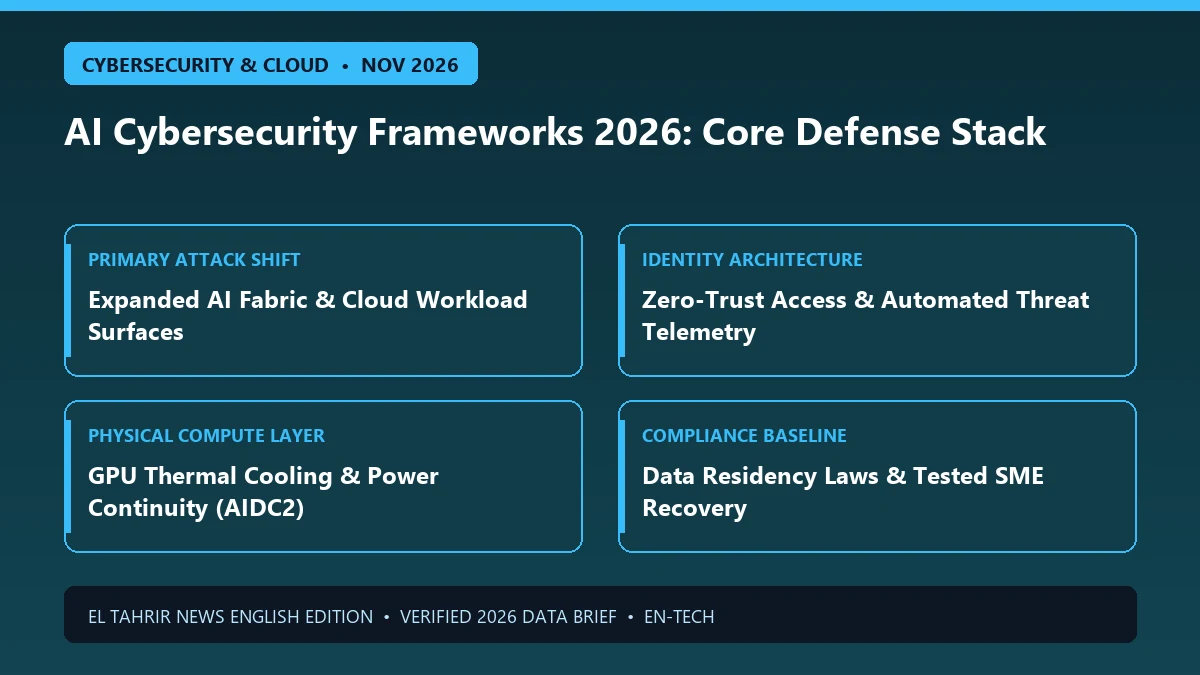
Securing AI Fabric workloads cannot stop at software firewalls; enterprise resilience depends equally on automated threat telemetry, zero-trust identity enforcement, and uninterrupted cooling and GPU power continuity inside the data hall.
AI Fabric Telemetry, Zero-Trust Controls, and Physical Continuity
Vendor demonstrations at AIDC2 translated policy goals into concrete architecture. Fortinet showcased methods for securing AI Fabric workloads through integrated threat telemetry, automated defense responses, and strict zero-trust identity controls across hybrid networks. Alongside software telemetry, Vertiv addressed physical resilience layers, specifically precision cooling and GPU power continuity, underscoring that high-density artificial intelligence racks introduce thermal and electrical availability risks directly tied to operational security. Security architects aligning enterprise controls with the NIST Cybersecurity Framework Official Guidelines increasingly treat physical uptime and digital access governance as one continuous risk surface.
| Defense Layer | Primary Risk Highlighted at AIDC2 | Recommended Enterprise Control |
|---|---|---|
| Generative AI & Cloud Automation | Widened enterprise attack surfaces across dynamic APIs | Continuous workload inventory and automated policy enforcement |
| AI Fabric Workloads (Fortinet) | Lateral threats inside high-speed cluster traffic | Integrated threat telemetry and automated threat containment |
| Identity & Access Architecture | Over-privileged service accounts and automated agents | Zero-trust identity verification for users and workloads |
| Physical Compute Layer (Vertiv) | Thermal stress and electrical interruptions on GPU clusters | Redundant cooling systems and continuous GPU power protection |
| SME Governance & Data Flows | Untested backups and fragmented regional compliance | Tested disaster recovery, continuous monitoring, MENA data alignment |
SME Disaster Recovery and Cross-Border MENA Compliance
While hyperscale enterprises showcased multi-region telemetry fabrics, CISO sessions also addressed small and medium-sized enterprises operating across Egypt and the broader Middle East and North Africa (MENA) market. For SMEs adopting cloud automation without large internal security operations centers, panel speakers emphasized practical fundamentals: tested disaster recovery procedures, continuous network monitoring, and strict adherence to cross-border data compliance regulations. Running regular recovery simulations ensures backups actually restore clean workloads after disruption.
Cross-border data compliance adds another operational priority for MENA companies serving clients across Gulf, Levant, and North African jurisdictions. Organizations deploying cloud-hosted AI services must document where training datasets reside, which entities hold cryptographic keys, and how audit logs satisfy national privacy mandates. Combining automated monitoring with clear disaster recovery runbooks enables leaner teams to maintain audit readiness without stalling digital transformation initiatives.
Frequently Asked Questions for Enterprise Security Teams
Why did Cairo ICT 2026 CISO panels warn about wider enterprise attack surfaces?
Panelists noted that generative AI tools and rapid cloud automation introduce new APIs, model endpoints, and automated workflows that expand an organization’s digital footprint faster than legacy manual perimeter reviews can monitor.
How do modern security frameworks address physical data center risks?
Beyond software controls demonstrated by Fortinet, AIDC2 speakers including Vertiv stressed physical resilience layers—especially cooling stability and GPU power continuity—so security monitoring and critical compute workloads remain operational under heavy loads.
What cybersecurity priorities matter most for MENA SMEs in 2026?
Regional SMEs are prioritizing tested disaster recovery drills, continuous monitoring across cloud assets, zero-trust access hygiene, and verified compliance with cross-border MENA data residency rules.

