

Unveiling six first-party Microsoft Ignite MAI Models in San Francisco during November 2026 marks a strategic pivot toward lower-cost, task-specialized enterprise computing. Reporting from El Tahrir News English Edition, Microsoft AI CEO Mustafa Suleyman outlined how proprietary coding, cybersecurity, audio, image, transcription, and decision systems now pair with an expanded 44-model Microsoft Foundry Model Router for organizations managing tight cloud budgets.
Table of Contents
San Francisco Keynote Shift Toward Cost-Efficient Specialization
Throughout November 2026, enterprise engineering leaders questioned whether paying flagship frontier token rates for routine software generation and log triage remained sustainable. Speaking from San Francisco, Mustafa Suleyman positioned Microsoft’s internally trained MAI family as a direct answer to those margin pressures, emphasizing models engineered specifically for software workflows, automated security triage, voice interaction, and enterprise decision support rather than general conversation alone.
That architectural move aligns with broader corporate governance discussions around enterprise cloud defense frameworks in 2026, where security teams increasingly demand high-context automated code inspection without triggering runaway inference expenses across production repositories.
Across the Middle East and global technology hubs, software vendors building regional cloud platforms face similar unit-economics choices, echoing priorities highlighted in sovereign AI infrastructure planning at Cairo ICT 2026 regarding localized inference efficiency and multi-provider resilience.
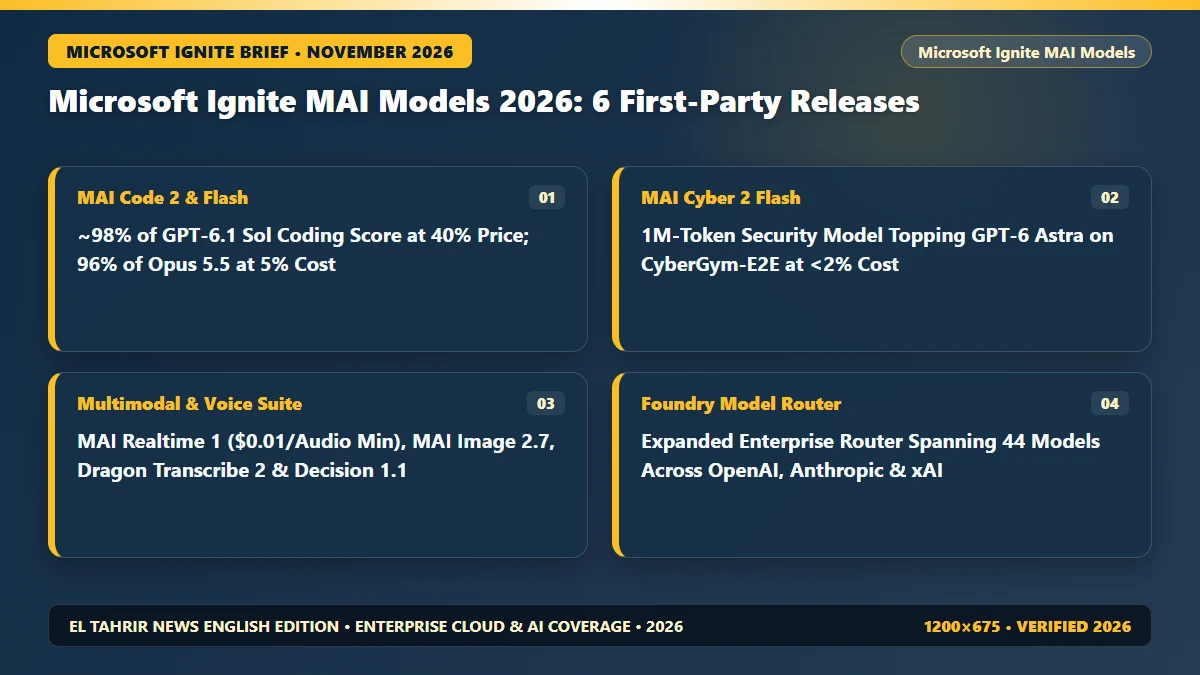
Six First-Party Microsoft Ignite MAI Models Explained
Rather than issuing a single monolithic checkpoint, Redmond introduced six targeted MAI releases tailored to distinct developer, media, and clinical-administrative pipelines:
- MAI Code 2 and Code 2 Flash: Integrated directly into GitHub Copilot, these coding specialists deliver roughly 98% of GPT-6.1 Sol coding performance at 40% of the price, and 96% of Claude Opus 5.5 benchmark capability at just 5% of the cost.
- MAI Cyber 2 Flash: Built with a 1-million-token context window for deep repository inspection, outperforming GPT-6 Astra on the CyberGym-E2E benchmark at less than 2% of the competing cost.
- MAI Image 2.7: An upgraded visual synthesis release tuned for fast commercial asset generation inside enterprise design workflows.
- MAI Realtime 1: A low-latency conversational voice and audio engine priced at $0.01 per audio minute for contact centers and live assistants.
- Dragon Copilot Transcribe (MAI Transcribe 2): An accuracy-focused speech-to-text release powering specialized documentation in Dragon Copilot.
- Decision 1.1: A structured reasoning and operational decision model designed to automate complex enterprise rule evaluation and workflow routing.
Achieving 96% of top-tier coding benchmark scores at 5% of the cost through MAI Code 2 transforms how software organizations budget automated code completion and security scanning across large engineering teams.
Performance Benchmarks, Pricing, and Official Microsoft Release
Engineering teams evaluating deployment timelines, GitHub Copilot availability, and Azure integration notes can consult the Official Microsoft Blogs Portal directly for release announcements. Key verified figures from the November 2026 San Francisco showcase include:
| Model Release | Primary Enterprise Role | Verified Benchmark or Pricing Metric |
|---|---|---|
| MAI Code 2 & Code 2 Flash | Software generation inside GitHub Copilot | ~98% of GPT-6.1 Sol at 40% price; 96% of Claude Opus 5.5 at 5% cost |
| MAI Cyber 2 Flash | 1M-context defensive cybersecurity | Outperforms GPT-6 Astra on CyberGym-E2E at <2% cost |
| MAI Realtime 1 | Live streaming audio and voice agents | Priced at $0.01 per audio minute |
| MAI Image 2.7 | Enterprise visual asset generation | Updated first-party image synthesis engine |
| Dragon Copilot Transcribe | Specialized voice transcription (MAI Transcribe 2) | Integrated into Dragon Copilot clinical and business workflows |
| Decision 1.1 | Structured operational decision routing | First-party decision intelligence model in Ignite 2026 suite |
How the 44-Model Foundry Router Reshapes Enterprise Cloud Stacks
Alongside first-party models, Microsoft expanded its Foundry Model Router to support 44 models spanning OpenAI, Anthropic, DeepSeek, xAI, and Meta. Instead of hardcoding a single model endpoint into every microservice, developers can assign routing policies that automatically dispatch complex reasoning prompts to frontier checkpoints while steering high-volume coding, voice, or security scans toward economical MAI variants.
That multi-vendor routing architecture reflects a maturing cloud software market in late 2026. Chief information officers no longer treat model selection as an all-or-nothing vendor lock-in decision; dynamic routing lets teams pair MAI Cyber 2 Flash’s million-token repository coverage or MAI Realtime 1’s one-cent audio rate with external partner models inside a single governed pipeline.
Frequently Asked Questions on Redmond’s 2026 AI Stack
How does MAI Code 2 compare with competing coding models in GitHub Copilot?
Inside GitHub Copilot, MAI Code 2 and Code 2 Flash deliver roughly 98% of GPT-6.1 Sol coding performance at 40% of its price and 96% of Claude Opus 5.5 performance at 5% of the cost, giving engineering teams frontier-grade code assistance on a sharply reduced budget.
What distinguishes MAI Cyber 2 Flash for security engineering teams?
MAI Cyber 2 Flash combines a 1-million-token context window with specialized vulnerability analysis, surpassing GPT-6 Astra on the CyberGym-E2E benchmark while operating at less than 2% of the competing inference cost.
Which external labs are supported in the updated Microsoft Foundry Model Router?
Microsoft expanded the Foundry Model Router to 44 models, giving developers unified routing across Microsoft’s own MAI lineup alongside models from OpenAI, Anthropic, DeepSeek, xAI, and Meta, plus $0.01 per minute audio processing via MAI Realtime 1.

